
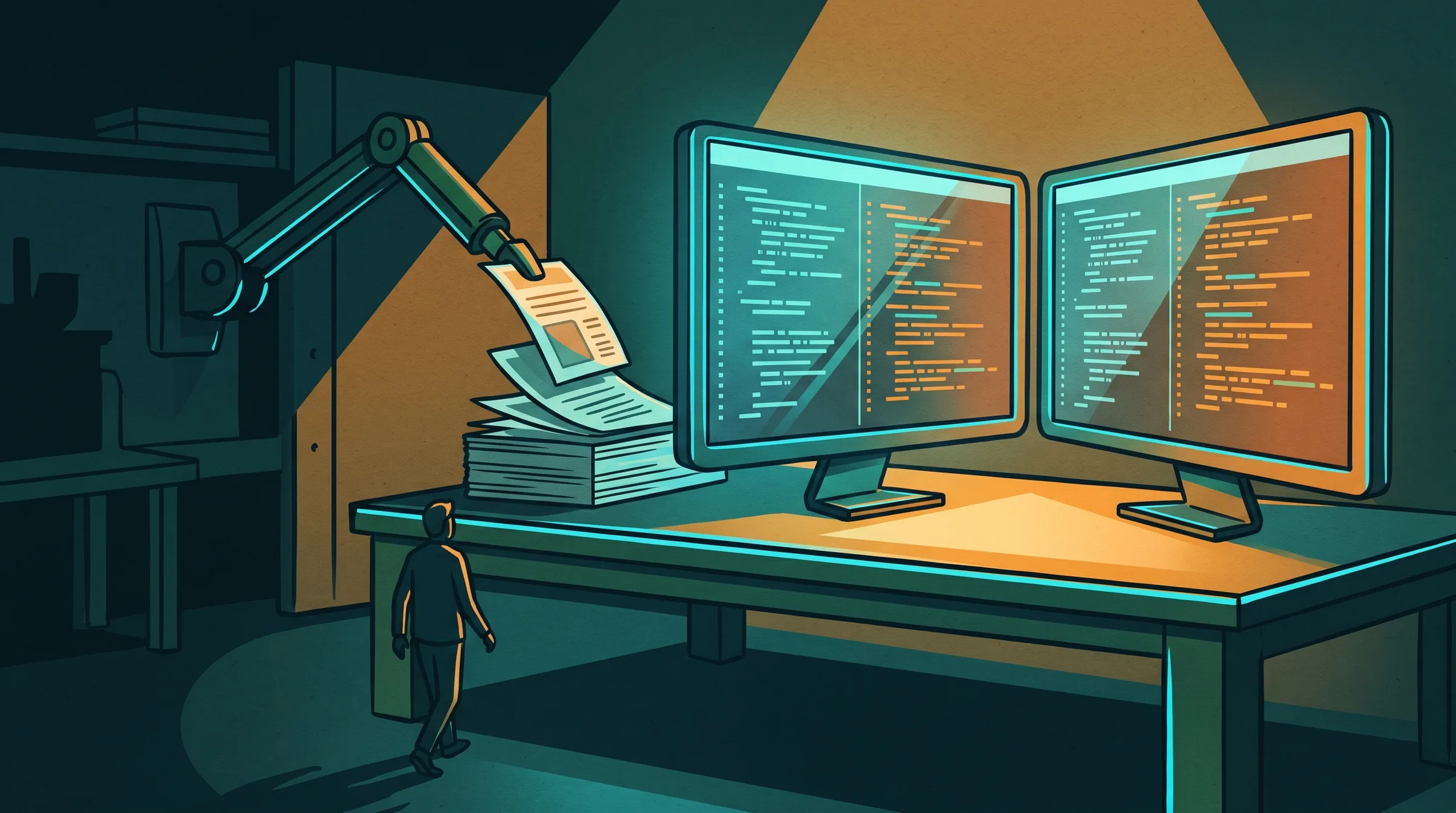
An operator Google places in the Russian-speaking world left a staging server open to the internet. Inside was a system that did the whole journey by itself: compare a web application's code before and after a security patch, work out what had been fixed, write the attack and run it. Nobody at the keyboard at any step.
What happened
The Google Threat Intelligence Group describes it in its quarterly report on how attackers use AI, covering the fourth quarter of 2026, and The Register picked it up. Google frames it as the first time it has seen the full cycle — finding the flaw and weaponising it — running without a human in the loop, and as a clear step up from what it was seeing three months earlier.
The framework is called exploit_agent, uses Russian-language tooling and wires several models together at once: some frontier commercial ones, some local models running on their own hardware. It was set up to watch widely deployed web application software on a continuous loop: code diff, vulnerability hypothesis, exploit, fire.
The same server also held:
- data already stolen from victim organisations;
- several post-compromise scripts: internal network reconnaissance, brute-forcing, installing webshells — back doors dressed up as web pages — and deleting other attackers' webshells;
- victim telemetry pointing mostly at French websites in media and entertainment, plus the education sector.
And it isn't a one-off. The report describes other groups — some financially motivated, some doing espionage, some with a Chinese nexus — moving on from typing prompts into a chat window to deploying multi-agent offensive frameworks: ARTEX, CAIRN, CyberStrikeAI, HexStrike AI, PentAGI. That last one, combined with proxy services, against the aerospace sector.
Why it matters
Diffing the code before and after a patch to work out the flaw was not invented this quarter. It's the classic n-day trade: exploiting a vulnerability that is already known and already fixed, against whoever hasn't applied it yet. What changes is the price and the tempo. Before, every diff needed someone who could read it and had an afternoon free. Now it's a loop running overnight, in parallel, across any project that publishes commits.
For anyone who builds or maintains software, that has three practical consequences.
Shipping the patch is shipping the vulnerability. It always was, but there were hours of human work in between acting as a cushion. That cushion is gone.
Being coy in the commit message buys you nothing. Not writing "fixes XSS" hides nothing when the reader is a machine comparing code trees, not messages.
Your patching window is no longer set by a human. If you don't have a list of what you expose to the internet and at which version, you have no way of knowing whether you're ahead or behind. Prioritise with CISA's KEV catalogue, which is precisely the list of what is actually being exploited.
One detail strikes me as the most telling in the whole report: the scripts that wipe other attackers' webshells. That tells you two things. One, there are so many people inside the same servers that they now get in each other's way. And two, if you inspect a compromised box and find no trace of anybody else, that proves nothing about it having been clean.
Look at the targets, too: French media and education. Not banking, not defence. Organisations with a lot of public web, a lot of plugins and very few sysadmins. In other words, most of us.
What doesn't change
Time to turn the volume down. What got exploited are not unknown flaws falling from the sky: they are already-patched vulnerabilities. Whoever applies updates within a short window is still out of reach of all this. The agent doesn't break cryptography or guess passwords — it takes advantage of you not updating.
Second: the server was found because it sat exposed with no protection. Hardly a showcase of flawless tradecraft.
Third, and this is what I miss most: there's no success rate. We don't know how many exploits came out working, or how many attempts went in the bin. Without that figure, "it does it on its own" covers an enormous range, from a production line to a contraption that lands one in fifty and has fifty thousand free attempts.
Fourth: botnets scanning WordPress have been doing the stupid version of this for a decade without a single language model.
Our take
The headline reads like science fiction and the substance is accounting. The point isn't that a model can write an exploit — we knew that — but that the marginal cost of turning a patch into a working attack is heading to zero. And when a cost hits zero, the technique isn't what changes: what changes is who is worth attacking. The plugin with four thousand installs never justified a person's afternoon. Now it joins the queue.
What I dislike is the framing. "No human involved" sells beautifully, and what it mostly sells is AI-powered detection products. The thing that actually moves the needle is desperately boring: knowing what you have published, at which version, and how long you take to update it. I'd bet most people reading this don't have that list finished and do have three security tools on contract.
What I think will age badly is the debate coming next: hide the patches, delay the diffs, publish less detail. We saw this with proof-of-concept releases years ago and it ended the same way — hiding the diff slows the attacker by hours and blinds the defenders for weeks. Bad trade.
What I'd do tomorrow is one single measurement: from the moment a security patch ships for the three or four internet-facing systems I run, how long until it's in production? If the answer is "it depends" or "next maintenance window", you already have the number that matters, and it isn't in Google's report.
That boring part — the inventory, the patches applied on time, the backups somebody has actually restored once to check they work — is literally half the job in the managed IT work we do. The other half is convincing people it isn't optional, and reports like this one help more than any slide deck.
Any questions, tell me and we'll go through it. Best, Vicente.