
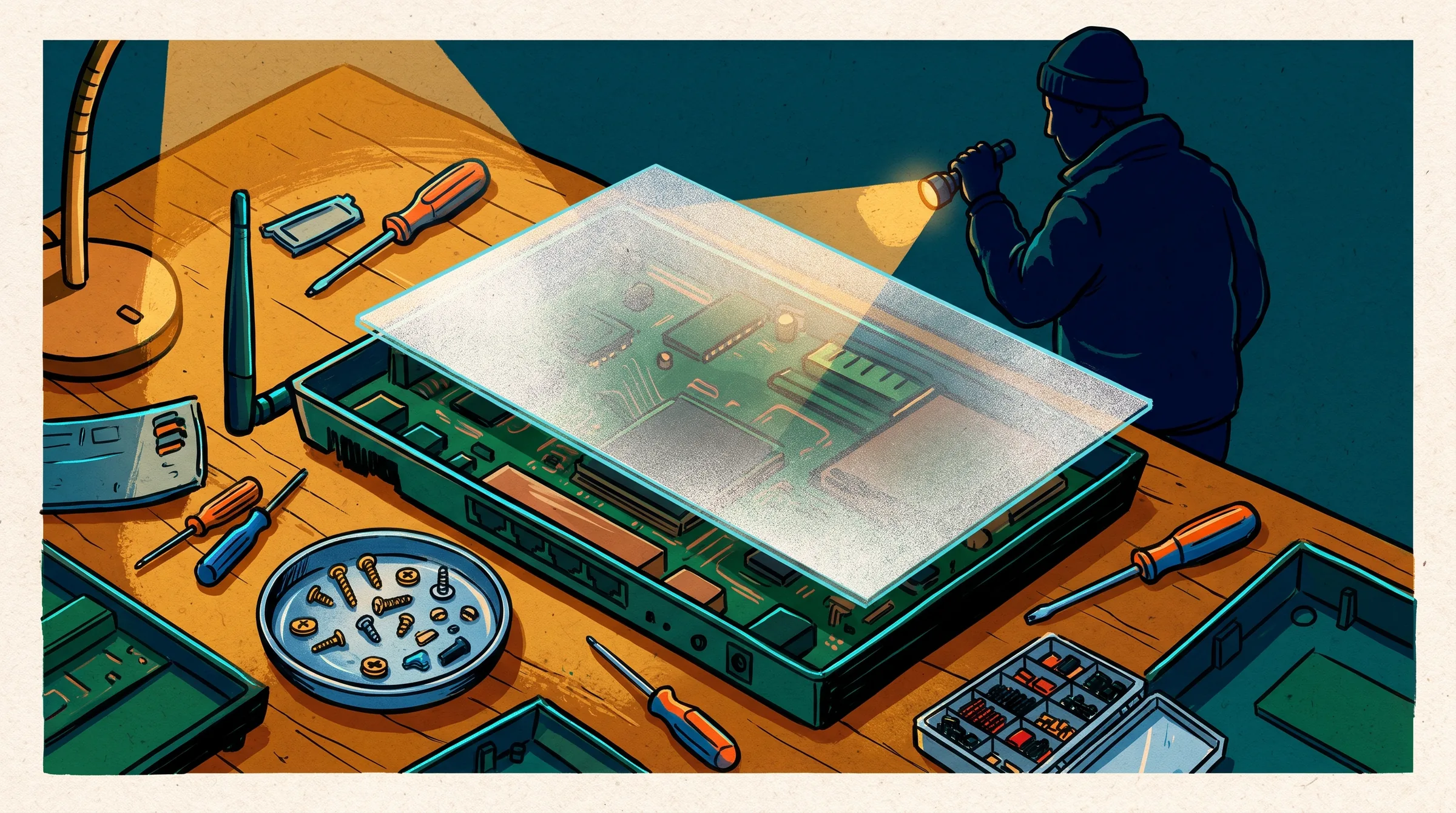
It didn't last long. For a few weeks, plenty of people worked out that they could ask Claude Code or Codex to help them decompile the firmware of some gadget they owned and bring it back to life: televisions full of ads and telemetry, internet-of-things devices abandoned by their makers, old hardware nobody is ever going to ship an update for again. This week 404 Media reports that the door is closing.
What happened
Several users have started running into safety checks inside Claude Code when they ask for something to be decompiled. A heavily upvoted thread in the Claude Code subreddit declares the trend dead — «The Dream is dead», it says — and in the Discord of the group that popularised it, Reverse Engineer Anything, several people reply to a message about Claude refusing by saying the same thing is happening to them.
On OpenAI's side it has gone further. An X user known as log4j, who had used Codex to pull apart Samsung televisions, says his account was shut down for «cyber abuse». Others report warnings or restrictions after asking for reverse engineering of their own hardware, or even of their own code. And Decomp.wtf, a project that made decompiling software and games easier, has shut down in the past few days.
An OpenAI engineer, Tarun Gogineni, came out to say these blocks are mostly unintentional, a side effect of where the classifier's boundary falls, and that there is no rule against reverse engineering with Codex. They're fixing it, in other words.
Why it matters
If your reading of this is «they've killed a hobby», you're missing the part that affects you. The category that trips isn't «decompiling televisions»: it's cyber. And the same region covers things we do in this trade every week.
Debugging a binary whose source you lost. Analysing a malware sample that landed on a client's machine. Working out a proprietary format so you can migrate data off a system the vendor no longer maintains. Talking to the PLC of an industrial machine whose protocol nobody ever documented. A contracted, signed-off penetration test. From the outside, all of that looks a lot like what someone who shouldn't be there is doing. And the classifier only sees the outside.
Matt Brown, a security consultant who has spent months using models to take devices apart, sums it up in what I think is the most important line in the story: the guardrails change without notice on the very same model. Not a new version. Same identifier, same prompt, and one Tuesday it stops working.
That doesn't break a conversation — you just try again. It breaks an automation. If you've built a step of a process on top of that behaviour, what you have isn't a bug: it's a dependency that evaporates with no changelog. Brown says plainly that he doesn't want to pour effort into an ecosystem that will eventually lock him out, and that he's buying hardware. Last week he published a video finding undocumented Bluetooth commands in a gas monitor strapped to his propane tank, using GLM 5.3, an open-weight model.
What I'd do from today, if I touch this: log every refusal with its prompt, keep a tested local-model fallback — tested, not «I'll sort it later» — and never build my own tooling on an endpoint whose content policy isn't part of the contract.
There's something bigger underneath. Researchers and law professors at Cornell Tech, Columbia and New York University published a paper last month on how cheap, AI-assisted reverse engineering strains trade secret law, copyright, anti-circumvention rules and computer misuse statutes. Their argument is simple: those laws were written assuming a barrier — time, expensive tools, rare skill — that agents are quietly erasing.
What doesn't change
Let's be fair to the story. No published policy bans reverse engineering; you can read Anthropic's usage policy and that line isn't in there. What exists is a classifier tuned strict for a believable reason: it costs a lab far more to appear in a headline for having helped an intrusion than for having annoyed a hundred hobbyists. Telling a legitimate pentest from an attack by looking at prompt text alone is a genuinely hard problem.
The blocks are also intermittent, and OpenAI says it's correcting them. Nothing is over, either: open-weight models work, they run locally, and nobody closes your account. What's lost isn't the capability — it's the convenience of opening a terminal and just asking.
Our take
What bothers me isn't the restriction. It's the shape of it.
I'd take a written «no» in the usage policy over a «sometimes» decided by a classifier that gets retuned with no version number. With the «no» I can plan: I read it, I argue with it, I go elsewhere. With the «sometimes» I have a system that worked during the proof of concept, that I told the client worked, and that one day returns a polite refusal. If the labs are going to keep these filters — and they will — the minimum is a distinguishable error code and a public note when the boundary moves.
We've seen this film. Antivirus products have spent decades deleting legitimate pentesting tools from the disks of the people who use them for a living. GitHub went through the same fight when it started pulling proof-of-concept exploits and half the security industry came down on it. The pattern repeats: a general-purpose platform tries to adjudicate intent on a dual-use activity, can't, and ends up ruling on whichever side carries the least legal risk. Which is almost always the big manufacturer's side.
And I think it will age badly for whoever did it. The novelist Bruce Sterling landed the obvious jab: it only gets called «reverse» when the person doing it isn't worth a trillion dollars. Training a model on half the internet is building a product; reading the firmware of the device you paid for is abuse. That asymmetry is hard to defend in public, and the practical effect is to push the most capable users towards open models — many of them Chinese, and improving fast — in precisely the use category where the most technical value was being created.
In our work, this is exactly what we run into when we put a model inside a company process: the fragile part is almost never the model, it's the dependency on a supplier that can change the rules on a Tuesday afternoon without telling anyone. That's why the first thing we look at isn't which model performs best today, but what happens the day that model says no.
Any questions, tell me and we'll look at it. All the best, Vicente.