
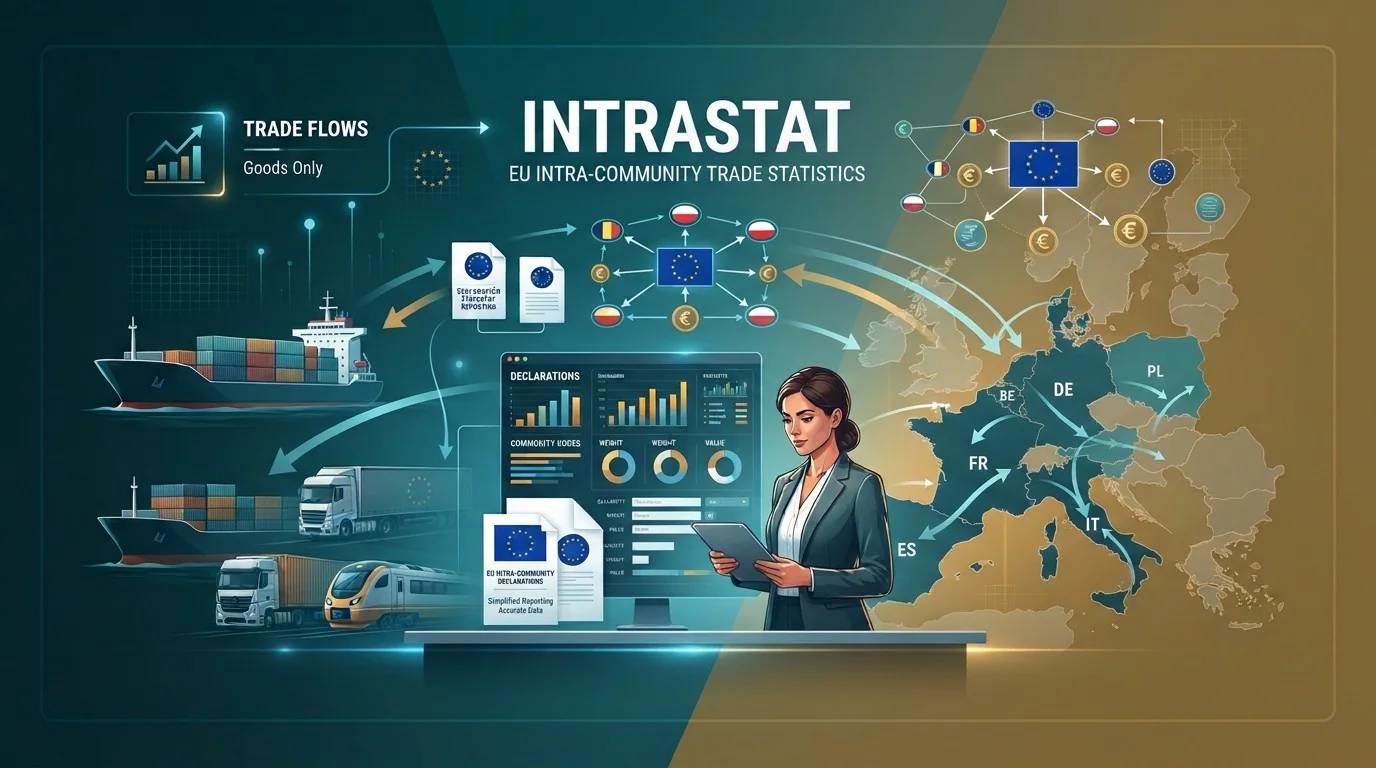
Intrastat is the return through which Spain records, month by month, which goods arrive from other European Union countries and which leave for them. It is not a tax: it is a statistic. But it is mandatory, it is filed with the Spanish Tax Agency, and it asks for data that is almost never in one place. That is why, for many companies that buy or sell within Europe, it is one of the heaviest tasks of the month.
What it is and how it differs from form 349
Form 349 is a tax return: it summarises intra-community transactions for VAT purposes. Intrastat looks at something else, the physical movement of the goods: how much they weigh, what they are under an official classification, which country they come from, how they travel. Those figures feed the statistics on trade between EU countries, which is why Intrastat asks for information form 349 does not need.
The rule that currently sets its content, deadlines and thresholds is Order HFP/1480/2021, in force since 1 January 2022.
Who must file
The obligation depends on an annual threshold measured separately for each direction of the goods. Today it is 400,000 euros both for the import flow, goods arriving from other EU countries, and for the export flow, goods sent to them.
- If you exceeded the threshold last year in a flow, you must report that flow every month of the year.
- If you reach it during the year, you start reporting in the month you exceed it, and that first return includes only that month's transactions.
- If you are obliged and a month has no transactions, you still file a nil return.
The two flows are independent: a company may have to report what it buys in Europe but not what it sells, or the other way round.
The change planned for 2027
On 25 September 2026 the Ministry of Finance opened a public consultation on a draft order amending Order HFP/1480/2021 to double the thresholds to 800,000 euros in both flows, applying to returns from January 2027 onwards. According to the figures accompanying the draft, reported by fiscal-impuestos.com, about 6,000 companies would no longer have to report exports and about 8,500 imports, around 30% of those reporting today, while the statistics would still cover more than 96% of the value of trade.
It is a draft, not an approved rule: as of this post it has not been published in the BOE, Spain's official gazette. Until it is, the 400,000 euro threshold applies. And anyone above 800,000 euros will keep reporting as before.
What data it asks for
Each line of the return describes one type of goods in one transaction. Besides identifying the company, the flow and the month, article 8 of the order asks for, among other things:
- The goods code in the Combined Nomenclature, the EU tariff classification, with eight digits.
- The net mass in kilograms, meaning the actual weight of the goods without packaging.
- Supplementary units, when the code requires them: litres, pairs, items…
- The value: the VAT taxable amount and the statistical value.
- The country of dispatch or destination and the country of origin of the goods.
- The nature of the transaction, as a two-digit code: sale, return, repair…
- The delivery terms, such as Incoterms, and the mode of transport.
- The province of origin, for exports, or of destination, for imports.
- The VAT number of the receiving company in the other country, for exports only.
When and how it is filed
It is filed electronically on the Spanish Tax Agency's website within 12 calendar days after the end of the month it covers. October's transactions are due by 12 November at the latest.
Why it takes so long every month
The problem is not understanding the form. It is that the data it asks for is scattered:
- The value is on the invoice.
- The weight is on the supplier's packing list, if it is complete, or on the carrier's delivery note, if it is not.
- The Combined Nomenclature code is almost never on any document: someone has to look it up, and the product record in the ERP does not always have it.
- The country of origin may not match the country the goods were shipped from.
So every month someone opens invoices, chases packing lists, asks for delivery notes, writes weights into a spreadsheet and looks up again codes they already looked up the month before.
How we automated it
For a medical supplies distributor that runs on Holded we built an Intrastat tool on top of its ERP data:
- It reads invoices from the ERP itself, or uploaded ones, and spots duplicates.
- It reads packing lists and transport delivery notes to get the weights.
- It takes the weight from the product record if the ERP has it. If not, it lets you enter it once and saves it.
- It remembers tariff codes and the rest of each product's data, so the next return asks for less.
- It generates the return ready to file with the Spanish Tax Agency.
The result is that each month takes less effort than the last. An invoice and a packing list that includes weights is usually enough; if not, you add the carrier's delivery note.
If your company prepares Intrastat by hand, or has the same problem with other tasks its ERP does not handle, we explain it in more detail in custom business dashboard and the tools your ERP lacks, with a free check-up.
We will update this post once the threshold rise is published in the BOE.