
If your privacy policy says you strip location data from the images your users upload, that sentence is worth a lot less than it was a year ago. Here's why.
What happened
404 Media has reported that Raven — the Graylark Technologies tool previously called GeoSpy — no longer just guesses where an outdoor photo was taken: it now points to the specific home from a picture of the inside.
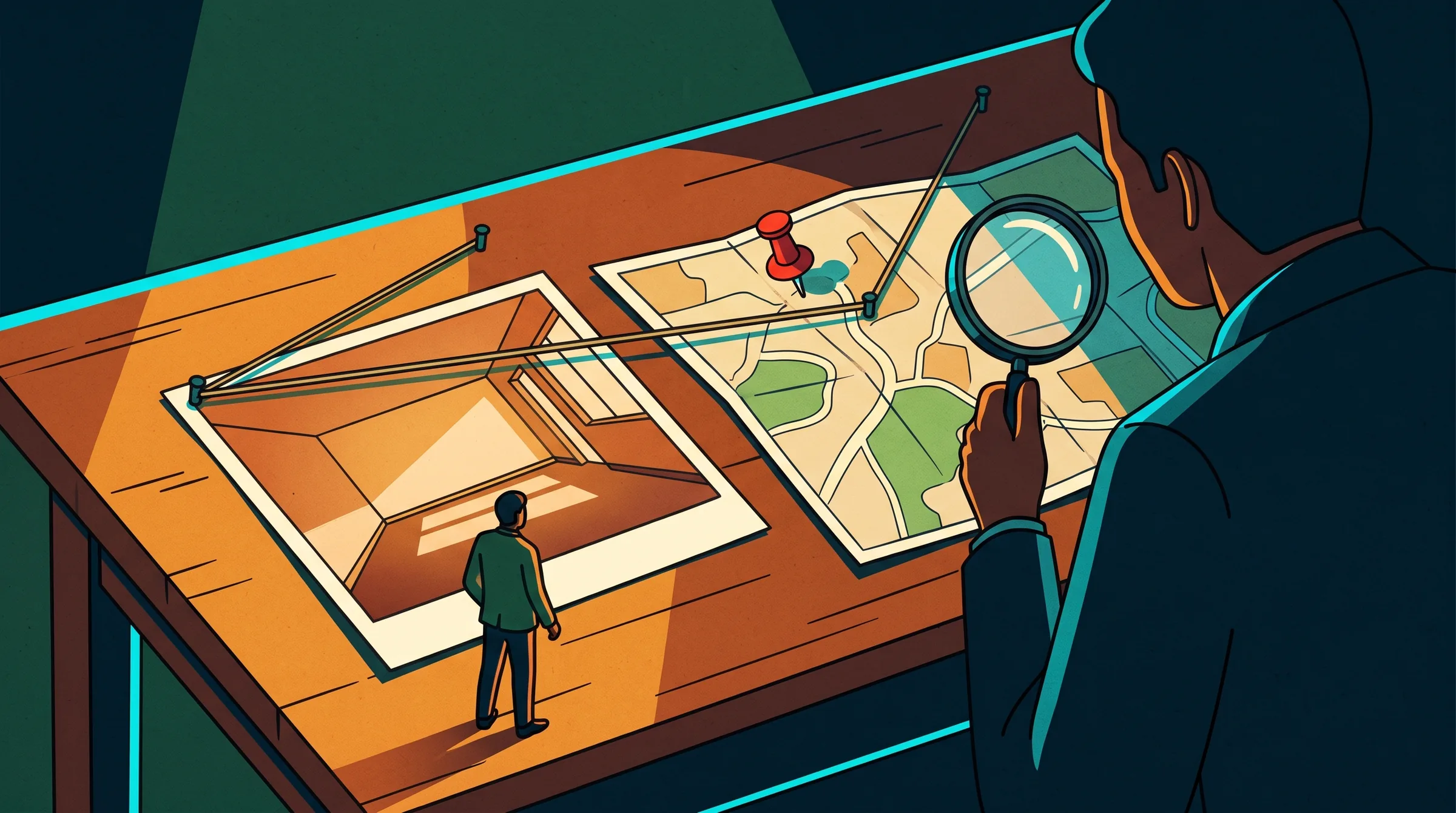
How it works, according to the promotional videos the company's chief executive, Daniel Heinen, posted on LinkedIn: you take a photo of a washer-dryer pulled from X, upload it, choose the property search and a region, and within a couple of seconds the map zooms into Charlotte, North Carolina, with a list of results. The top one quotes word for word the headline of a specific Airbnb listing, and the photos in that listing show the same property. In another example, a bathroom photo taken from social media leads to Montecito, California, and the top result matches a Vrbo listing. In a third, from a year ago, a room leads to a specific address in San Francisco and the tool returns photos identical to those posted on Zillow.
This is not reverse image search. Reverse search finds the same photo somewhere else. This identifies features of the room and finds different photos of the same property, taken at another time.
Three more points that matter. One: the Los Angeles Police Department and the Miami-Dade Sheriff's Office had already bought access, and the latter had a model trained specifically for its county — the interface itself refers to city-specific property models, so coverage isn't global. Two: Heinen says that in 2026 they'll invest heavily in interior geolocation across US hotels, short-term rentals, houses and flats. Three: Airbnb and Zillow told 404 Media that scraping their data breaches their terms; Vrbo didn't reply.
And the most interesting part, from an earlier interview with Indicator. Heinen explained how they found the capability:
I'll be honest, we didn't train it to do that.
While testing the second version of the model, he uploaded a selfie taken in a bathroom and it dropped a pin on San Francisco. He went over to Zillow, started screenshotting images, and it got the right city nine times out of ten.
Why it matters
The capability emerged on its own. This is the bit that should worry you if you train or deploy models. They trained on millions of geotagged images assuming they were outdoor shots — architecture, vegetation, soil type. Indoor photos slipped into the pile: people at a party, a plate on a worktop. The model learnt to associate interior details with places, and nobody asked it to. A model's capability surface is bigger than its spec, and you find out the difference when someone stumbles on it. Sometimes that someone is you, testing. Sometimes it isn't.
Stripping metadata has stopped being a control. For fifteen years, "we anonymise images" has meant, in practice, "we delete the EXIF". Airbnb said exactly that: location metadata is excluded from listing photos, and the address is only shared after a booking is confirmed. All correct, and all insufficient, because the location is no longer in the file header: it's in the pixels. The tiling, the skirting board, the window, the make of the radiator. If your product handles interior photos — insurance claims, property management, refurbishments, remote assistance, engineers' reports — your privacy clause describes a control that has quietly expired.
The moat isn't the model, it's the corpus. What makes Raven useful isn't the guessing: it's having millions of listing photos indexed to compare against. That's why they're investing city by city, and why Airbnb and Zillow are talking about terms of use. Translated to your situation: everything you publish openly — your catalogue, the photos of finished jobs, the screenshots on your blog — is somebody's corpus. Putting it behind a terms-of-use page doesn't stop that; it just gives you someone to sue afterwards.
What doesn't change
The videos are marketing, and 404 Media says so: we don't know whether they represent Raven's real speed or accuracy. The Miami-Dade Sheriff's Office spokesperson had already stated that its use was limited and largely exploratory, with no significant investigative breakthroughs or arrests, and that no case outcome rested mainly on the tool.
It also can't find what was never published. If your home has never been listed on a portal, there's nothing to match it against. A neighbourhood with no listings is an empty index.
And mind that nine out of ten: it was getting the right city, not the address. Heinen himself frames it as a verifiable lead, not as proof. The real risk isn't the model being wrong — it's someone taking the top result in a list as a fact and acting on it.
Our take
What grates isn't the police use: there you at least have a contract, a file and someone to ask. It's January 2025. The tool was open to anyone, and people in its Discord server were asking for help tracking down women. It was restricted to government and enterprise users one day after a journalist rang to ask about it. That's the usual pattern: capability first, controls later, and only once not having them starts to cost something.
The "we didn't train it to do that" line strikes me as honest, and I appreciate it — I'd like to see that candour in more places — but it's precisely the admission that the control arrived late. If your model learns things you didn't ask for, the time to go looking for them is before you sell it, not while you're running a demo with a photo of your girlfriend.
What I think will age terribly is the EXIF clause. It's copied and pasted into hundreds of privacy policies and European impact assessments, and it now describes a control that doesn't protect against what it claimed to. If I had to change something this week, I'd change two things: treat user photos as personal data in themselves, with no reliance on metadata — the GDPR talks about identifiability, not file headers — and cut how long you keep them. What isn't on your disk can't leak.
This is exactly what we run into when someone wants to put a model to work on images inside a business process: the hard part is never the model, it's deciding how long the photo stays, who gets to see it, and what happens the day the supplier changes hands.
Any questions, tell me and we'll go through it. All the best, Vicente.